
Blog
Aging in Place: A Practical Guide for Families

Aging in Place: A Practical Guide for Families
Quick Summary: Aging in place works best when your loved one’s home, daily routine, and support system continue to meet their needs. This guide helps families assess whether aging at home is still a good fit, determine if any safety modifications need to be made, how to create a care plan, and understand how home care for seniors can help fill in any gaps in support.
“I want to stay in my own home.”
If you’ve heard an aging parent say this, you’re certainly not alone. Home is familiar. It holds routines, memories, neighbors, and the comfort of knowing exactly where everything is.
But as a family member, you may have another question in the back of your mind: Can they continue living there safely and comfortably as their needs change?
AtThe Legacy at Home, we’ve helped older adults and families across Dallas and Plano with care that helps make aging at home more manageable. We also know that successful aging in place often takes advance planning. That’s why we created this guide for families to help you evaluate your loved one’s situation, determine if any modifications need to be made, and make a plan with your loved one for the years ahead.
Is Aging in Place Right for Your Parent?
When thinking about whether aging in place at home is right for your parent, the decision involves more than whether someone is capable of living on their own. Families also need to think about whether the current environment and caregiving responsibilities will work long-term as your loved ones’ mobility, health, and/or support needs change over time.
Begin by looking at a typical day rather than envisioning future events. What is working right now? What isn’t working? What do we need to make a plan for?
This checklist can help guide you as you ask yourself these questions:
Aging-in-Place Readiness Check
- Can my loved onemove safely around the home?: Are there any potential tripping hazards? Are there piles of clutter that need to be removed?
- Are they managing medications reliably?: Is your loved one taking the right dose of their medication? Do they ever forget to take their medication or take an incorrect dose?
- Can they prepare meals and shop for groceries on their own?: When you visit, is there food in the fridge? Are they eating and cooking for themselves? Do they remember to turn off the stove? Are cooking utensils stored in places they can easily reach?
- Are bathing, dressing, and other personal routines manageable?: Are they keeping up with personal hygiene and other activities of daily living (ADLs)? Are they experiencing any incontinence issues?
- Do they have reliable transportation?: Are they still able to navigate familiar areas? Are there any vision or health issues that prevent them from driving or taking public transportation? :
- Is someone available if they need help unexpectedly?: Do they have neighbors, friends, or relatives close by that could help them or transport them to a hospital if needed? Are they able to navigate a smartphone to call 911?
- Are they staying socially connected?: Do they still get together with friends? Are they still involved in community activities or have they pulled back?
- Can they keep up with laundry, housekeeping, and basic home tasks?: Is the laundry downstairs? If so, are they still able to navigate the stairs on their own?
- Does our family have a realistic plan if they need more help later?
A few “not sure” or “no” answers do not automatically mean your parent isn’t able to age in place. However, they may reveal where additional support might be needed.
Start With a Home Safety Check
If aging in place is a good fit for your loved one, take a look around their home to determine if any modifications need to be made.
The CDC reports that more than 1 in 4 adults age 65 and older report falling each year, making fall prevention an important part of home safety. Even small details, such as lighting, loose rugs, stairs, or bathroom surfaces, should be examined carefully to identify any potential fall risks.
Instead of trying to renovate everything at once, start with the spaces your parent uses most:
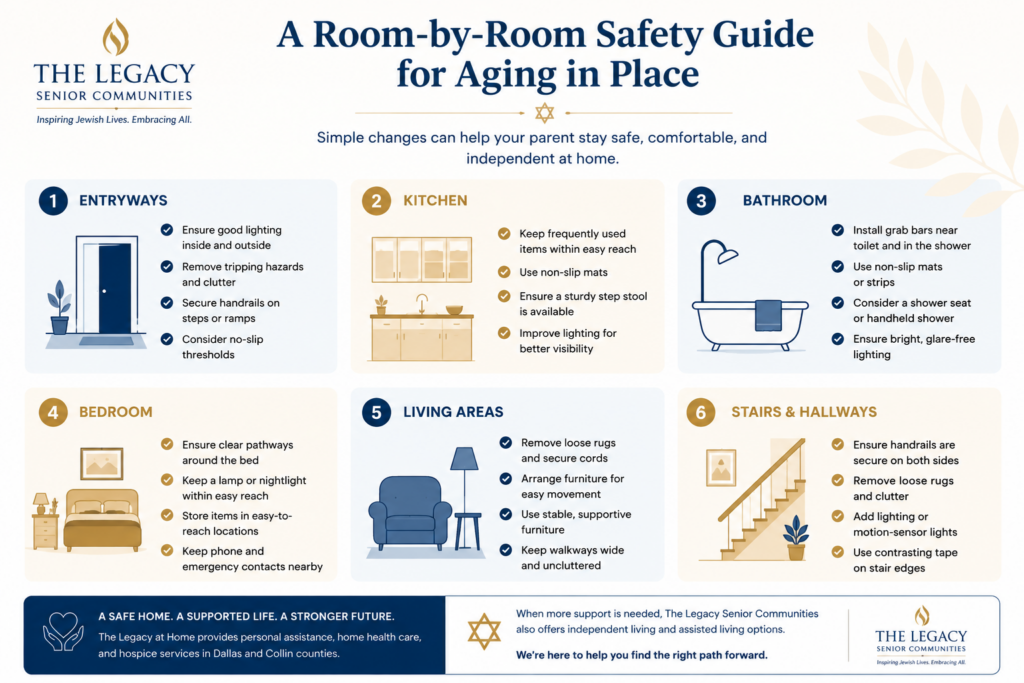
- Bathroom: Can they get in and out of the shower or tub easily? Grab bars, nonslip surfaces, better lighting, or a shower seat may help make the space safer and easier to use.
- Stairs and hallways: Look for anything that could make walking less secure. Clear clutter, secure railings, improve lighting, and remove loose rugs or cords from the path.
- Kitchen and living areas: Keep frequently used items within easy reach, so your parent does not have to climb or stretch. Arrange furniture so there is enough space to move comfortably between rooms.
The National Institute on Aging also recommends keeping cords away from walking paths, arranging furniture so it does not obstruct movement, and storing commonly used items where they are easy to reach.
You can also use this room-by-room safety guide to spot simple changes:
Look Beyond Home Safety
A home can be physically safe and still become difficult to manage. That is why families should also look at activities of daily living and ensure that any gaps in support are covered.
When evaluating what level of support your loved one may need to age in place at home, many families realize that the question is more than just “Can Mom or Dad remain at home on their own?” It’s also “Where can we find some additional support to make sure their needs are covered?”
Many adult children of older parents are managing caregiving responsibilities on their own or splitting responsibilities between their siblings. While your love and dedication for your parents knows no bounds, sometimes you’re unable to provide the level of support they need. You may have work and children of your own to take care of too. This is incredibly common. Studies show that more than 60% of caregivers experience burnout.
While the solution may look different for every family, many families find that support from professional in-home care services can help.
Benefits of In-Home Care Services
Family support can make a major difference, but it does not have to cover every need. If your parent wants to age in place, but they need help with managing day-to-day tasks, in-home care services can help fill specific gaps without taking away their independence.
The Legacy at Home offers families in Dallas and Plano, TX, different levels of home care for seniors depending on each individual person’s needs what is needed.
1. Personal Assistance Services
Even if your parent does well managing most things on their own, some tasks may be harder than before. Perhaps getting ready takes longer, errands feel more tiring, or you’ve noticed that you’re stepping in more often to help with things they once managed on their own.
Our Personal assistance team can step in where needed, with in-home care services such as:
- Bathing, dressing, and grooming
- Light housekeeping and laundry
- Transportation and errands
- Medication reminders
- Companionship and caregiver respite
The idea is not to take over, but to make aging at home more manageable for your loved one and your family.
2. Home Health Care
Coming home after surgery or an illness can bring a different set of needs. Your parent may be ready to return home but still require professional care during recovery.
With home health care, your parent can receive skilled medical support at home, including:
- Skilled nursing
- Physical and occupational therapy
- Speech therapy
- Home health aide services
- Medical social services
Home health care can help your loved one recover in a familiar, comfortable environment at home.
3. Hospice Care
If the focus of care shifts from treating symptoms to providing comforting palliative care, families need skilled, caring support from professionals trained in hospice care. The Legacy at Home Hospice provides end-of-life care and support for:
- Pain and symptom management
- Emotional and spiritual support
- Medications, equipment, and medical supplies
- Grief support for families
As a Jewish-sponsored organization, we honor Jewish traditions surrounding death and mourning while respecting people of all faiths and beliefs. Our hospice program is also accredited by the National Institute for Jewish Hospice (NIJH).
Revisit the Plan as Your Parent’s Needs Change
Aging in place is an ongoing process that should be re-evaluated on a regular basis. A plan that works today may need to change after a fall or hospitalization, a change in mobility, or increasing difficulty with everyday routines.
Determine a cadence for reviewing your loved one’s plans for aging in place with them, as well as fellow caregivers in your family and your loved one’s physician. Here are a few questions you can ask to evaluate if any adjustments need to be made:
- Start/Stop/Continue — What is working well that we should continue doing? What is something we should start doing to make the plan work better for everyone? Is there anything that isn’t working anymore?
- Is your loved one still managing daily routines comfortably? Have their needs changed recently?
- Is the family feeling stretched?
- Would adding more at-home care for aging parents make things easier?
If needs become difficult to manage safely at home, it may also be worth learning about other supported-care options.
These conversations can be difficult and challenging. It’s good to keep in mind that having these conversations now and continuing to revisit the plan can help prepare everyone involved in your loved one’s care for any unforeseen situations. If your loved one does experience an injury or needs to be hospitalized for any reason, your family and your loved one’s care team will be more prepared to make the best decisions for them.
Making Aging at Home Work For Everyone
When caring for people we love deeply, many people take on too much or disregard their own well-being. They feel a sense of duty and accountability for taking care of their loved ones, the way they took care of them growing up. However, it’s important to keep in mind that your loved one may someday need more care than you can possibly give. And in some cases, the best care may require specialized training or skills that you don’t have. There’s nothing wrong with asking for help—sometimes the best thing you can possibly do for your loved one is to find them the right care.
The Legacy at Home provides personal assistance, home health care, and hospice services for older adults in Dallas and Plano, giving families options for additional support that allow their parents to stay where they feel comfortable. And if their needs or preferences change over time, The Legacy Senior Communities also offers independent living and assisted living options, so families can explore the level of support that feels right for what comes next.
Our team of caring, knowledgeable experts is here to support you throughout your loved one’s aging process. Whether you have questions, need more information, or you’re just not sure what the next right move looks like, we’re happy to help.
Contact us today to talk through your loved one’s support needs. Together, we can ensure they receive the compassionate care they deserve in the place they call home.
Frequently Asked Questions
What does aging in place mean?
Aging in place means continuing to live in your own home as you grow older, with changes or support added as needed to help you remain safe and independent. That may include home modifications, family assistance, personal care, or professional in-home care services.
What home care for seniors can help someone age in place?
Home care for seniors may include non-medical personal assistance, help with daily routines, companionship, transportation, skilled nursing, therapy, or other healthcare services depending on the individual’s needs. The right level of support depends on what your loved one can manage independently and where additional help would make daily life safer or easier.
How do I find in-home senior care near me?
Start by looking for a provider that serves your area and offers the type of support your loved one actually needs, whether that is personal assistance, home health care, or hospice. It can also help to ask about caregiver qualifications, availability, care planning, and how services can change over time. For families in the Dallas and Plano areas, The Legacy at Home provides in-home care services that can support older adults as their needs evolve over time.