Blog
7 Questions to Ask a Home Care Agency

Quick Summary: Choosing home care in Dallas for a loved one often requires looking beyond the services listed on their website. In this guide, The Legacy shares seven questions to ask a home care agency about qualifications, screening, and flexible options, along with a visual checklist.
Where can I find a home care agency in Dallas, TX, I can trust with my loved one’s care?
If you’re asking yourself this question, you know how much careful consideration is involved in the search for a home care provider that meets your loved one’s needs. After all, you’re inviting someone into their home to help with their everyday needs, their routines, and, in some cases, their health care.
While many agencies may appear to offer similar services, there may be important differences in caregiver qualifications, training, care planning, availability, and communication. Knowing the right questions to ask empowers you to feel confident in making a well-informed decision.
The Legacy at Home has been providing home care in Dallas and Plano for years. We understand the questions families often have when choosing care for a loved one. To make the process easier, we’ve put together a list of seven questions worth asking as you compare home care agencies in Texas, along with a handy checklist to help you review options.
What Kind of Home Care Does My Loved One Need?
Before you begin comparing home care agencies for seniors, take some time to think about the kind of support your loved one needs every day.
“Home care” is often used broadly, but not all in-home services are the same. Two of the most common types are:
- Personal Assistance: Focuses on non-medical support with activities of daily living (ADLs), which may include bathing and dressing, meal preparation, medication reminders, as well as mobility assistance, errands, companionship, and respite coverage for family caregivers.
- Home Health Care: Provides skilled healthcare services at home, which may include skilled nursing, physical therapy, occupational therapy, speech therapy, or other services following an illness, injury, surgery, or hospital stay.
Your loved one’s needs may also change over time. Understanding what they can safely manage on their own, where they need help, and whether skilled medical care is required will make it easier to determine which agencies are worth considering.
Read our Home Health Care vs Personal Assistance blog to learn more about the differences between these options.
7 Questions to Ask a Home Health Care Agency
1. What Services Do You Provide, and Are They the Right Match for My Loved One?
Start with the basics. Ask which services the agency provides and whether it has experience supporting needs similar to your loved one.
It’s also worth looking beyond your loved one’s immediate needs. Can services be adjusted if they eventually need more hours, additional help, or a different level of care? Choosing a provider with a wider range of care options may make it easier to adapt as those needs change.
For example, The Legacy at Home offers multiple different types of in-home care in Dallas and Plano, including:
- Skilled Nursing: Managing medical conditions, medication, and post-surgery care.
- Physical Therapy: Helping seniors regain strength, mobility, and function after illness or injury.
- Occupational Therapy: Assisting with daily living activities to help seniors remain independent.
- Speech Therapy: Supporting communication and swallowing abilities.
- Home Health Aide Services: Assistance with activities of daily living (ADLs) such as bathing and dressing.
- Medical Social Services: Helping seniors navigate emotional or social challenges and connect with necessary resources
2. What Are the Home Health Care Qualifications for Your Staff?
The person providing care may spend significant time alone with your loved one, so it’s important to understand how the agency selects, trains, and supports its team.
Ask what qualifications are required for each role, how team members are screened before they are hired, and what training they receive. For skilled services, confirm that nurses, therapists, and other professionals have the appropriate credentials for the care they provide.
Ask whether ongoing education or competency checks are required and who supervises the care team. You should also know who to contact if you ever have a concern.
Home Health Care Qualifications
Look for the following list of home health care qualifications when evaluating agencies:
- Background checks and other pre-employment screening
- Clearly defined qualifications for different roles
- Training before team members begin working independently
- Ongoing education or competency checks
- Regular supervision
- A clear process for reporting and addressing concerns
If an agency simply says its caregivers are “highly trained” or “experienced,” ask what that means in practice.
3. Are You an Accredited Home Health Care Agency?
Credentials offer another way to evaluate home health care agencies in Dallas beyond what’s available online or the details shared during your initial conversation.
The types of accreditation that are the most important depend on the type of care your loved one needs. If you’re considering skilled home health care, ask whether the agency is Medicare-certified. Depending on the provider and service, there may also be relevant state licenses, professional accreditations, or independent quality measures.
Don’t hesitate to ask what a credential actually means, which organization issued it, and whether it can be independently verified.
What to Look For
The agency should be able to tell you:
- Which licenses, certifications, or accreditations apply to the service
- Who issued each credential
- Whether the credential is current
- Where you can verify it
- Whether quality ratings or other independent measures are available
The Legacy at Home is a Medicare-Certified Home Health provider. We are recognized as a leader in the field of senior care. Our Personal Assistance services have received a five-star rating from the Centers for Medicare and Medicaid Services (CMS).
4. What Is the Process for Creating and Updating My Loved One’s Care Plan?
Good home care should take into account more than a list of tasks that need to be completed during each visit.
Ask whether an assessment takes place before services begin and how your loved one and your family will be involved in developing the ongoing care plan. The conversation should consider factors such as health needs, abilities, routines, preferences, and goals.
You’ll also want to understand how the plan works day to day. Ask how visit schedules are determined, what happens during a typical visit, and how often the plan is reviewed.
Most importantly, find out what happens when circumstances change. If your loved one returns home after a hospitalization, becomes less mobile, or starts needing more support, how will their care be reassessed?
5. Will My Loved One Have Consistent Caregivers?
Seeing a familiar face can make receiving care at home more comfortable, particularly when someone needs help with personal routines.
Ask whether your loved one will typically see the same caregiver or a small group of caregivers. You can also ask how the agency matches people and whether they consider factors such as personality, communication style, schedule, routines, or preferences.
Of course, no agency can guarantee that the same person will always be available. Illness, vacations, emergencies, and staffing changes happen. What matters is how those changes are managed. Ask how substitutions are handled, how your family will be notified, and what happens if your loved one does not feel comfortable with a particular caregiver.
6. What Happens in an Emergency or When a Caregiver Can’t Make It?
Unexpected situations happen, which is why it’s better to understand the agency’s procedures before you need them.
If a caregiver becomes sick shortly before a scheduled visit, will someone else be sent? How quickly will your family be notified? If your loved one depends on assistance with an important part of their daily routine, what backup arrangements are available?
You should also ask whom to contact outside regular business hours and what team members are expected to do if they notice a concerning change in your loved one’s health or well-being.
7. How Does Billing Work, and What Will Care Cost?
Cost should not come as a surprise after care has already started.
Ask the agency to explain how its rates are calculated and exactly what is included. Depending on the service, you may also want to ask about minimum visit requirements, evening or weekend rates, cancellation fees, and additional charges.
Then ask about payment options and insurance coverage.
How you pay for care depends largely on the type of service your loved one receives. Medicare may cover qualifying home health services under certain circumstances, while non-medical personal assistance is generally paid for differently. Private insurance benefits can vary as well.
Rather than assuming something will or will not be covered, ask the home care agency to explain which payment options may apply and what costs your family could be responsible for.
Ideally, important pricing and billing information should also be available in writing so your family can review it before agreeing to services.
Checklist: Questions to Ask a Home Care Agency
You don’t have to ask every possible question during your first conversation. Once you’ve narrowed down your options, a few additional questions can help you understand what working with an agency may actually look like.
Here’s a quick checklist of all the important questions to ask a home care agency before making your final decision:
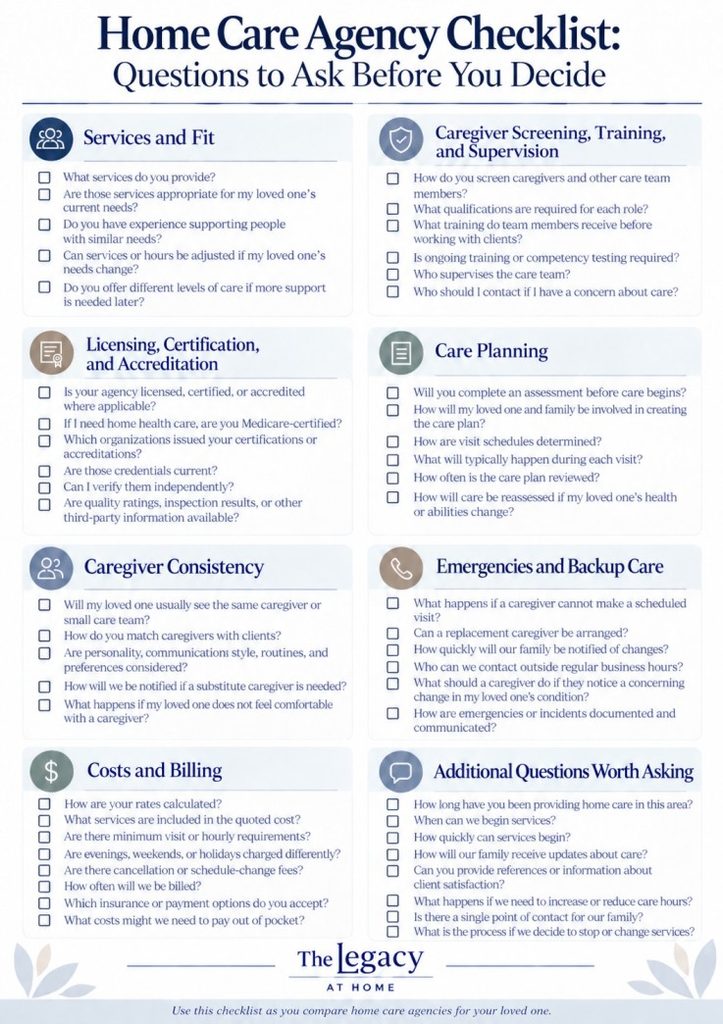
Keep this checklist with you when speaking with different home care agencies. Asking similar questions can make it easier to compare agencies based on the things that matter most to your loved one and family.
Choosing Home Care in Dallas and Plano, TX
Choosing a home care agency is about more than finding someone who can complete a list of tasks. Finding a team that respects your loved one’s routines, preferences, dignity, and desire to remain as independent as possible at home can make all the difference in their daily quality of life.
At The Legacy at Home, care is designed around the person. We offer a full range of home care services for seniors in Dallas and Plano, including:
- Home Health Care: Skilled nursing, physical therapy, occupational therapy, speech therapy, and medical social services for older adults recovering from illness or surgery, or managing ongoing health needs.
- Personal Assistance Services: Non-medical support with bathing, grooming, meal preparation, errands, companionship, and medication reminders, helping older adults remain comfortable and supported at home.
- Hospice Care: Compassionate end-of-life care focused on comfort, dignity, and support for both the individual and their family.
The Legacy offers a full continuum of care, which means support can change as your loved one’s needs change—from short-term recovery and personal assistance to more advanced care and hospice. That can give families greater continuity without having to start over with an entirely new provider at every stage.
If you’re looking for home care in Dallas or Collin County, feel free to contact our team. We’re here to help answer questions and provide helpful guidance so you can find the right home health care for your loved one.